
Begin Again, Begin Softly
Returning to Your Practice When Routine Falls Apart

Hi Friends,
It’s Friday. At noon Eastern, we’ll gather to write together, in a shared hour of attention and care. Come live if you can. Join later if you can’t. The door stays open either way.
If you’re part of the Salon, you can enter here. If you’re new and feeling curious, you’re welcome too:
👉 [Join the live writing practice or watch the replay]
Sliding-scale options are available. If cost is a barrier, just reach out—no questions asked.
There’s a particular feeling to the days between Christmas and New Year’s. Time loosens, and structures soften. The usual rhythms that organize our lives—work schedules, routines, expectations, meals—fade at the edges.
Some people call it no man’s land.
In this in-between, it’s common for writing practices to fall apart. Not because the voice has disappeared (in fact, many of us have quite a lot to say over the holidays) but because the conditions that support it have shifted.
If your writing hasn’t looked the way you hoped this week, nothing is wrong.
Voice isn’t something we summon through discipline alone. It’s relational. It responds to safety, pace, and rhythm. When routine dissolves, many writers try to force their way back, setting stricter rules, demanding output, pushing harder. That rarely works.
Research on habit formation tells us that consistency isn’t built through intensity or willpower. It’s built through small, repeatable actions that fit our actual lives. When a practice feels achievable, we’re far more likely to return to it, especially during times of disruption. This is why gentler structures matter more, not less, when things feel unmoored.
Try ten minutes instead of an hour, or one honest sentence instead of a page.
Try a notebook on the couch instead of a desk, or, better yet, choose rest and trust that it counts. Or, if you’re called, gather with us to write gently into the end of the year, you’re warmly invited to join us.
Voice doesn’t vanish when routine falls apart. It waits for conditions it can trust.
Here’s a practice inspired by my book Narrative Healing:
A Practice: Returning to the Page Gently
Before you write, create conditions that signal safety.
Place your feet on the floor. Let your spine lengthen without effort. Rest one hand on your heart, and the other on your belly, or anywhere that feels steady.
Take a slow breath in. Let the exhale be a little longer than the inhale.
Now ask yourself, quietly: What feels possible right now?
Not what you should write. Not what you meant to write this week. Just what feels possible in this moment.
Set a timer for 10 minutes.
Begin writing from this single prompt:
“Right now, this is where I am.”
Stay close to sensation rather than memory. If the mind races ahead, return to the feeling of your feet, your breath, your hand on your body.
You don’t need to stay on one topic. You don’t need to make meaning.
Let the writing wander, pause, or circle.
When the timer ends, stop—even if you’re mid-sentence.
Stopping is part of the practice, it builds trust between you and the page, and it makes returning easier next time.
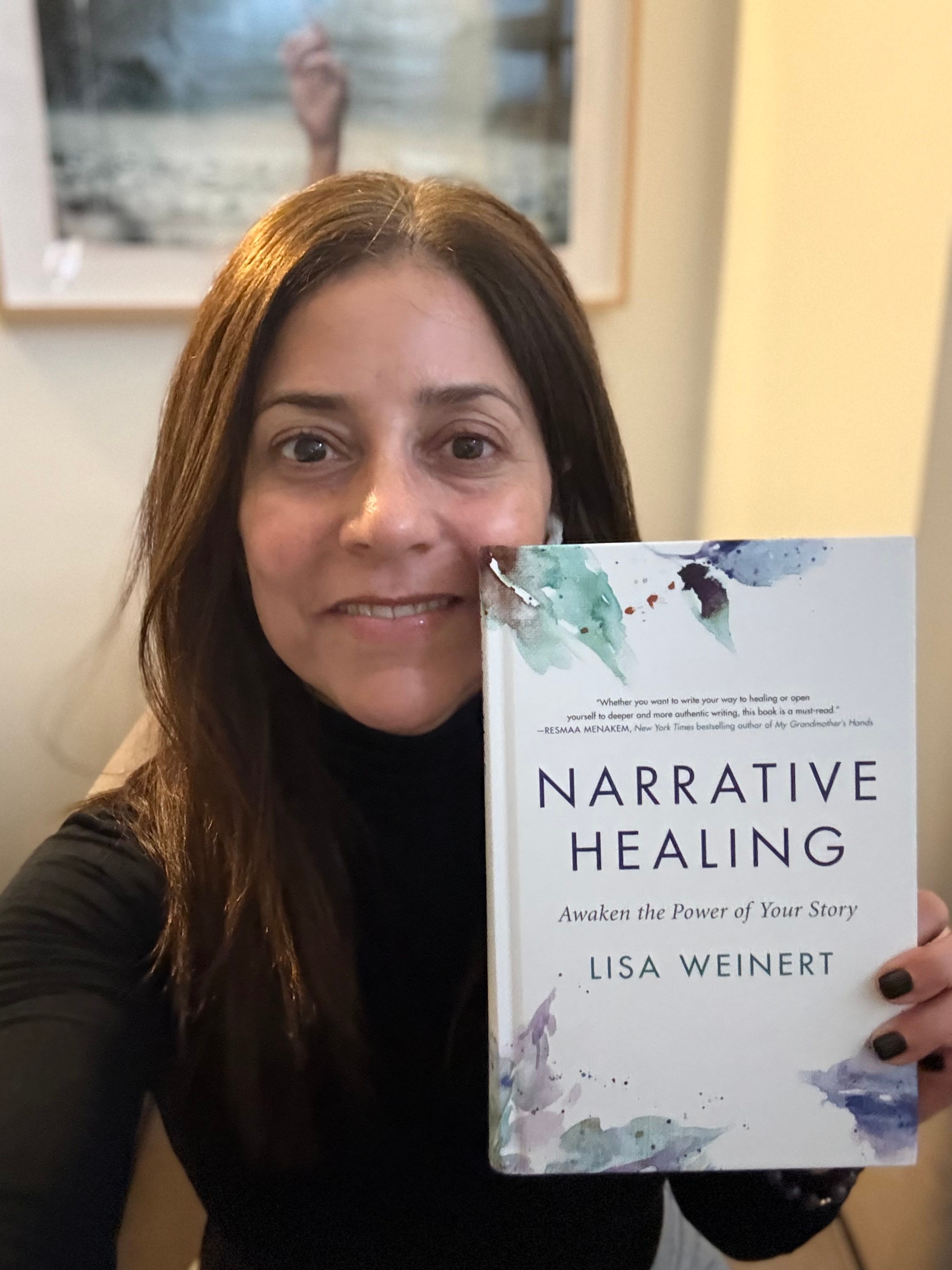
This practice comes from the Narrative Healing approach I’ve been developing and teaching for years, and from my book, Narrative Healing: Awaken the Power of Your Story. You can get a copy <here>.
You don’t need to understand what arrived on the page today. Showing up is enough.
This is how a writing life is rebuilt, not through force or resolution, but through returning again and again with soft intention. This is also why we gather to write together each week, inside the Narrative Healing Salon Community.
If today feels like the day, join us live at 12 noon Eastern. If not, the replay will be there when you are.
You don’t need to start over; you don’t need a new system. You can simply begin again. And, you can start softly.
With care,
Lisa
P.S. I’m shaping a six-week, online Narrative Healing writing practice grounded in everything we’re exploring here—habit formation, nervous system care, and writing as a sustainable way of living with our stories.
It will be self-paced and accessible, designed to meet you where you are rather than ask you to keep up. I’m planning to open it soon, in time for the new year. I’ll share more when it’s ready.