
The Work That Found Me
On trauma-informed care, storytelling, and becoming a social worker

Dear Friends,
I’m sitting with a humbling truth these days: after years of study, late nights, uncertainty, growth, and becoming, I’ve completed my coursework for my Master’s in Social Work at Fordham University, passed the LMSW exam, and will officially graduate on May 19.
It feels less like arriving at a finish line and more like stepping more fully into the work I’ve long been circling all along—the work of story, healing, listening, and what it means to accompany one another through change.
In many ways, this work began with my own healing journey through mental health and recovery, where I came to depend on writing and storytelling as an essential part of staying connected to myself.
It had always been a lifelong dream of mine to write a book, but I never could have imagined that publishing Narrative Healing would eventually lead me toward a degree in social work.
The path here has been rigorous and demanding. Full of long days and moments that asked more of me than I knew how to give. And also: moments of connection, meaning, and unexpected grace.
What I can name clearly is gratitude.
For the professors, supervisors, colleagues, and friends who now make up a network of care I had been quietly longing for.
When I began bringing Narrative Healing more fully into the world after publishing my book, it emerged in the wake of the pandemic, during a time shaped by collective strain, grief, violence, division, and uncertainty. In room after room—corporate spaces, classrooms, retreat centers, studios—I encountered something shared: a palpable sense of collective trauma, even when no one named it directly.
And I began to notice something else.
When people approached their stories from a more grounded and embodied place, something shifted. I consistently witnessed moments of clarity, connection, emotional release, and insight. Over time, people also began coming to me with experiences that extended well beyond writing—sharing stories of grief, relationship struggles, caregiving, alcoholism, addiction, trauma, anxiety, depression, and major life transitions.
I found myself asking deeper questions:
How can I hold this work with greater ethical care?
How can I better understand trauma, systems, and mental health?
How can I support people responsibly while staying within the integrity of my role?
Several mentors encouraged me to pursue an MSW, but there was one moment in particular that clarified the decision for me.
I was invited to teach an online writing-for-self-care program for staff at Everytown for Gun Safety. Before I began, the Director of Trauma Programs, Abby Hurst, introduced the workshop in a way I had never quite experienced before.
I had spent years teaching in classrooms, retreat centers, conferences, and executive spaces, where I was usually simply introduced and then began. But Abby approached the room differently.
Before we started, she carefully explained what participants could expect, what we would and would not be doing, and emphasized choice throughout the experience. She specified that participants could have their cameras on or off. She acknowledged that some prompts may bring up unexpected emotions, and encouraged participants to take care of themselves and take breaks if they needed to. The differences were subtle, but powerful. It created a sense of clarity, inclusion, and safety that I could feel immediately, not only in the room, but in my own body.
The room settled.
There was a shared understanding of how we were entering the work together. I felt my shoulders drop. I felt myself exhale. I hadn’t realized how much I had been holding until that moment.
I had already been integrating grounding practices, mindfulness, and body awareness into my work, but there was a precision and intentionality to this trauma-informed framework that deeply moved me.
It stayed with me.
I realized I didn’t want to continue doing this work in the same way. I wanted to understand how to create spaces with that kind of care, clarity, and ethical grounding.
I began to realize that what felt so different about the way Abby held the room was rooted in the fact that she was a social worker.
By October, I had applied to Fordham University, and by January, I was enrolled as a Merit Scholar.
The past two years have given me something I didn’t have before: a stronger clinical framework, a deeper understanding of trauma and systems, and a greater sense of responsibility for how this work is held.
Alongside my coursework, I completed two years of field education.
My first placement was at James Lenox House on the Upper East Side, a residential community for older adults, where I provided case management support and developed a monthly Writing for Wellness program that culminated in a community open mic.
In my second year, I returned to Everytown for Gun Safety, where my understanding of trauma-informed care had first begun to shift, completing my field placement with the Survivor Network and Trauma Programs team under the supervision of Abby Hurst, a social worker and Director of Trauma Programs. My work focused on developing trauma-informed writing programs for both staff and survivors, using reflection and storytelling as tools for connection, emotional processing, and support.
Under Abby’s supervision, I created a seven-week Writing for Resilience program for gun violence survivors focused on grief support, resilience, and belonging. I also developed a four-week Writing for Wellness program for staff centered on caregiver reflection, connection, and sustainable care practices to address burnout.
Each of these experiences continues to deepen and shape how I understand this work as both a writer and an emerging clinical social worker.
I’m beginning to see more clearly the relationship between writing and the ways we grow, heal, and connect. In this context, writing becomes more than creative expression. It becomes a practice of staying connected to the present moment, deepening self-awareness, and giving language to lived experience.
From that place, greater clarity, insight, connection, and even joy can emerge.
This has become the foundation of how I now approach writing: as a trauma-informed practice grounded in presence, reflection, nervous system awareness, choice, and care.
What continues to move me most is how accessible this practice can be. Writing is not reserved for professional writers or any particular group of people. It can become a tool for reflection, regulation, creativity, connection, and healing, and a way of returning to ourselves and one another.
As I move through these final weeks before graduation, it feels less like an ending than a beginning. This work has changed me in ways I’m still learning to name.
In the months ahead, I’ll be sharing more about these programs, what I’ve learned through this training, and how Narrative Healing continues to evolve at the intersection of storytelling, mindfulness, and social work.
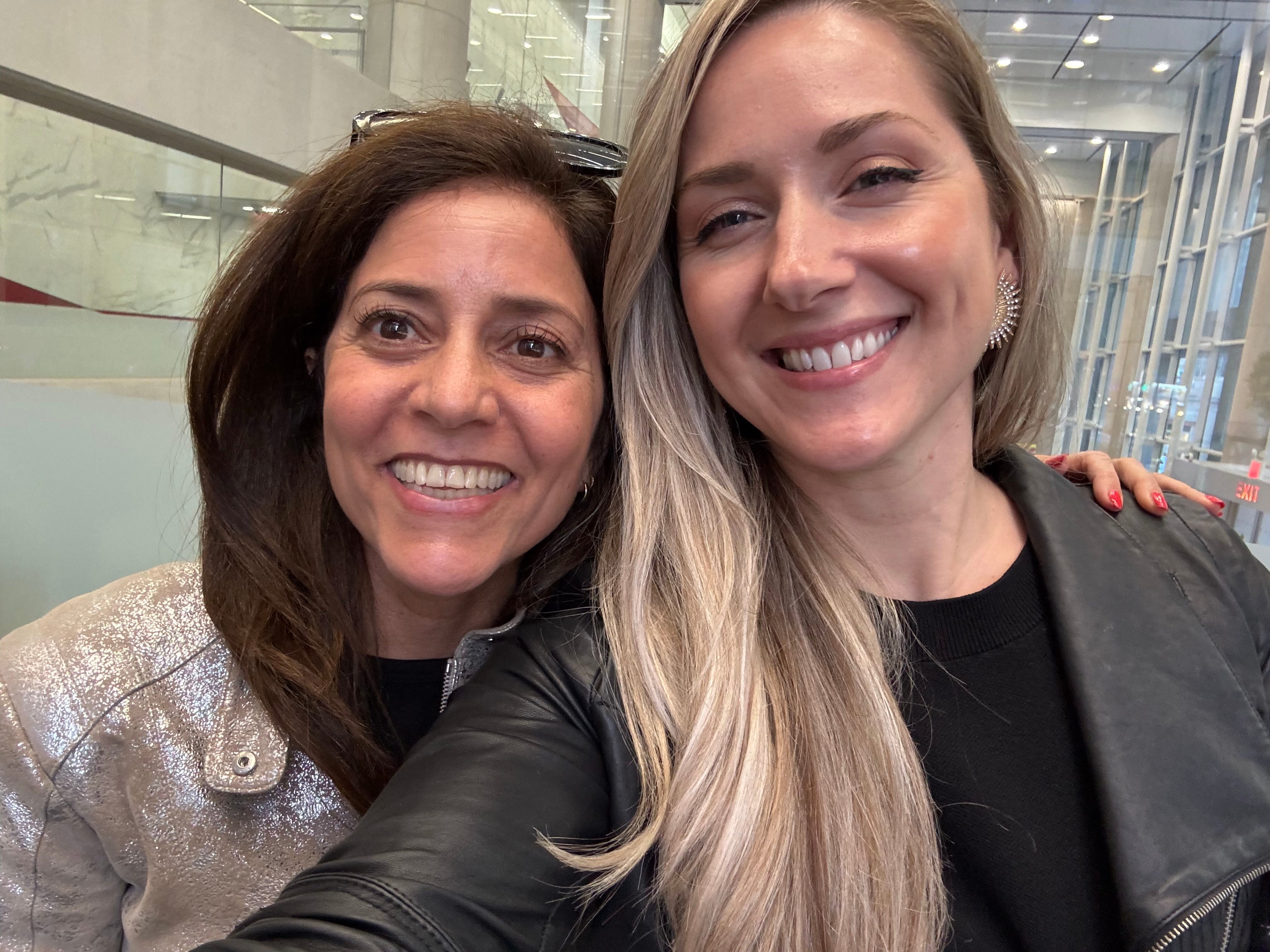
(Last day at Everytown for Gun Safety with Abby Hurst 🤍 Grateful for this chapter and the people who made it meaningful.)
A Writing Invitation
As I reflect on the past two and a half years, I find myself thinking not only about the moments that changed me, but the people who carried me through them. Professors, supervisors, clients, patients, survivors, and community members who taught me that our stories are not simply problems to solve, but experiences to be listened to, honored, and held with humility, care, and responsibility.
If it feels supportive, I’d love to invite you to reflect on your own creative life in this way. On the moments that have stayed with you, and the people who may have quietly or profoundly shaped your path.
Prompt
Think of a turning point from the past year.
A decision, a shift, or a moment of knowing.
Or you might begin with a person,
someone who has shaped your creative life, directly or indirectly.
What did that moment, or that relationship, make possible
What shifted, opened, or became clearer?
You might follow that thread to now:
How has it shaped where you are?
And, if it feels accessible:
How might you be reauthoring your life?
Congratulations! This is such an inspiring story and I'm thrilled for what's ahead for you! Your work has supported me and continues to do so. Thank you for all you do!
Congratulations on achieving this wonderful, well-earned milestone, Lisa! I love this post. You’ve captured the tender yet transformative subtleties trauma-informed practices yield so perfectly, and it’s been a gift to experience how you’ve woven them into the NH Lab experience.
Social work is such a powerful conduit for so many disciplines. I was really fortunate to learn with and from an amazing social worker early on when I became a service designer and it fundamentally changed my brain and my body. I’m so excited to have another fascinating thing to talk with you about soon and look forward to more reflections about these amazing programs you created! 😍